

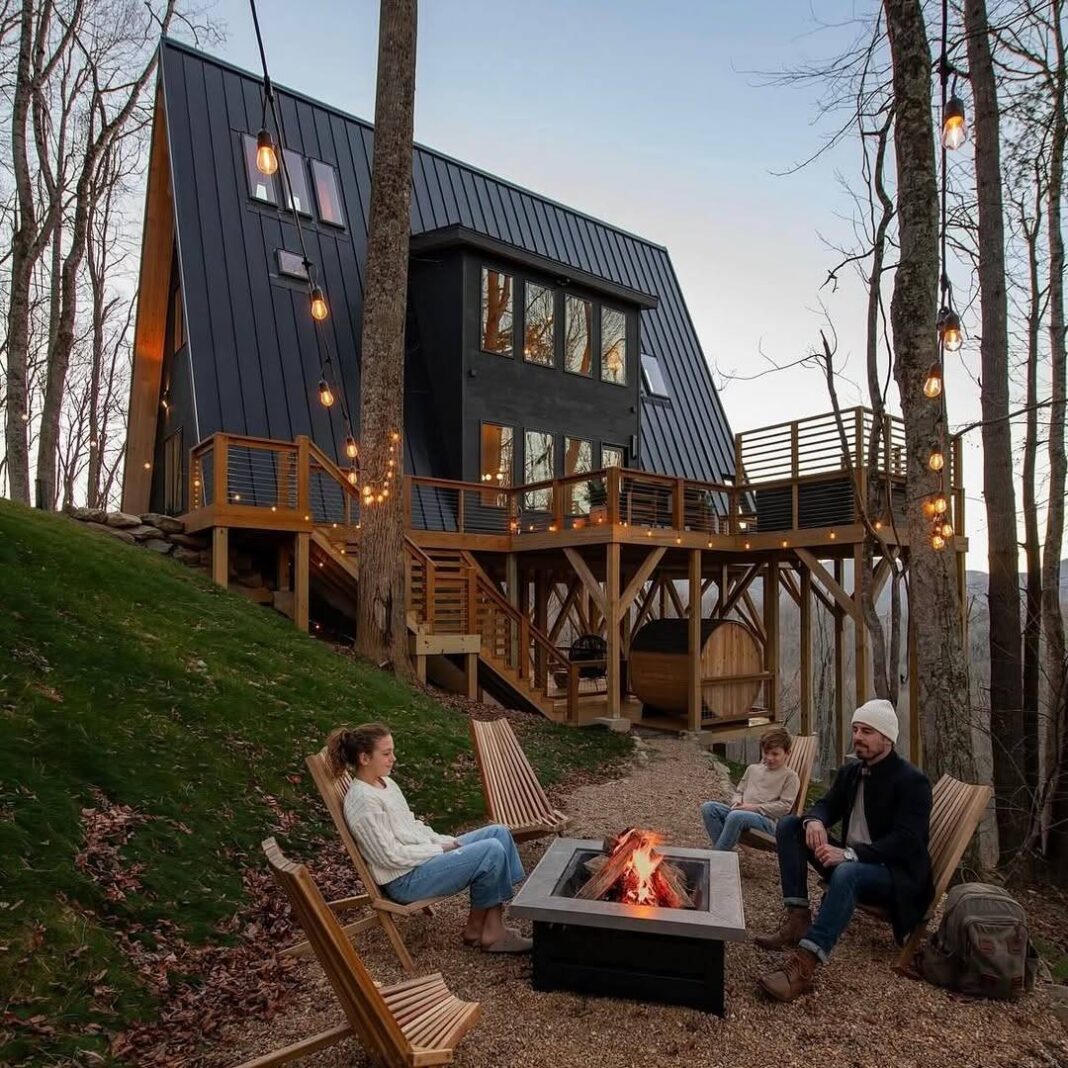

We humans love to try something new every now and then. Imagine a Triangle house in a breath-taking lake side or in the serene forest, we would die to find out the ambiance those scenarios hold and that’s how we get rich by unimaginable life experiences. Technology brings comfort to people and the easiness it offers is unmatchable with anything else. If you have a fine plot and have enthusiasm about trying something new every worthwhile, this article may inspire you well. Read and consider sharing it with someone you think would enjoy the info very much. Keep glowing 😊
1. An Easy Briefing

A. The Definition:
In the A- frame buildings, the main or major structure contains two angled beams that systematically join at the top and they are braced horizontally along the middle portion to eventually form an A shape.
The A- frames usually have a bold geometry symmetrical about the ridge line with the extreme steep pitch of the roof, so that walls on both sides can also act as roof.
In most cases, the windows are found on the gable ends and some mostly add dormers to the roof for extra sunlight and usable space.
2. The History

A. Origins in Global Traditions:
The A- frame first developed in countries where climate and tradition impacted architectural expression long before it became popular in the United States.
Japanese Gassho farmhouses named from the “praying hands” motion mirrored in their steep rooflines and it first appeared during the Edo period (1603-1868).
Their towering, angled interiors were perfect for growing silkworms and storing agricultural supplies.
In New Zealand, Maori Marae were built with dramatic triangular shapes to represent ancestors and also serve as the focal point of cultural gatherings.
Swiss Chalets and European Alpine constructions used sharply pitched roofs to shed heavy snowfall and endure mountain weather.
These early prototypes shared their important characteristics like durability, simplicity and symbolic meaning which paved the way for the A- frame’s modern evolution.
B. Rise of American A- Frame:
The American A- frame tale originated in 1934 when Austrian architect Rudolf Schindler created a sleek – modern A- frame holiday home near Lake Arrowhead, California.
Although ahead of its time, its design would spark a midcentury movement propelled by rising confidence and economic prosperity.
Following World War 2 American families achieved new levels of affluence. Car ownership surged and mortgages were more affordable and many families were able to buy modest vacation homes.
Architects like John Campbell and Andrew Geller capitalized on this cultural shift, designing striking, cheap A-frame cottages that were widely featured in lifestyle magazines.
Their designs combined modernism and approachability, with clean lines, dramatic forms and whimsical appeal.
By the 1950s and 1960s, the A- frame was popular.
Prefabricated kits from organizations such as the Douglas Fir Plywood Association and Sears enabled average Americans to construct their own retreats over some weekends.
The A- frame embodied the spirit of freedom, relaxation and achievable escape.
C. Decline and Re- Invention:
As the 1970s moved on, mass production drained the A- frame’s uniqueness.
Once a symbol of creative life it became overused and devolved into kitsch as fast expansion altered mountain and lakeside communities.
The architectural trend declined in the 1980s and 1990s, when luxury resorts and larger vacation homes became the new status symbols.
However, the A- frame was far from gone.
Following the 2008 financial crisis, reduced budgets and changed values reignited interest in compact, nature – connected and minimalist living.
Young customers and designers embraced small cabins, van conversions, tiny residences and environmentally friendly buildings.
During this cultural shift, inspired in part by internet communities and “Cabin Culture” movements, the A- frame restored its position as an accessible, elegant and lifestyle-driven architectural option.
D. Modern A- Frame:
Modern A- frames combine mid- century elegance with current ideas such as off-grid living, renewable materials, clean architectural lines and modular prefabrication.
Brands such as Den, Backcountry Hut Company and Avrame provide customizable designs ideal for distant retreats or full-time minimalist living.
Despite their appeal, A- frames have some drawbacks, slanted walls limit storage and usable floor space in which insulation can be challenging and interior arrangements demand imagination.
However, their advantages are identically compelling like structural strength, efficient utilization of materials, snow-shedding roofs and distinct style.
E. Enduring Legacy:
The A- frame’s journey reflects cultural and economic shifts throughout generations.
It has evolved from old farm structures to postwar holiday landmarks and modern eco-friendly residences.
Its universal appeal of simplicity, whimsy, affordability and connection to nature makes it more than just an architectural trendy design. It symbolizes escape.
3. Advantages
They are inexpensive to build because it requires, compared to other architectural styles, less materials and labor costs.
It offers a combined roof and wall, within a compact footprint, maximizing the vertical square footage.
Similar to the triangular basis of bridges and trusses, the A- frame’s triangular architecture is considered as the most stable and strong shape of any structure especially with its floor joists and roof rafters.
Since the steeply pitched roofs of A- frames would not entertain snow and rain, it is perfect for Cold and rainy climatic regions.
The fond memories that you have as a child of vacationing in an A- frame house wont fade away that easily or, Am I wrong?
4. Disadvantages:
The biggest downside of these structures are its sloped walls. In its practical sense, putting furniture and walking towards the outer corners is not possible.
Hence those parts of A- frame homes remain underutilized.
Which gives us a feeling of congestion and disorganization stems because things only and can be placed in the center of A- frames.
The inner temperatures could be in the extremes during winter and summer days and placing a cooler in the upper levels would be a much better idea in the summer days.