

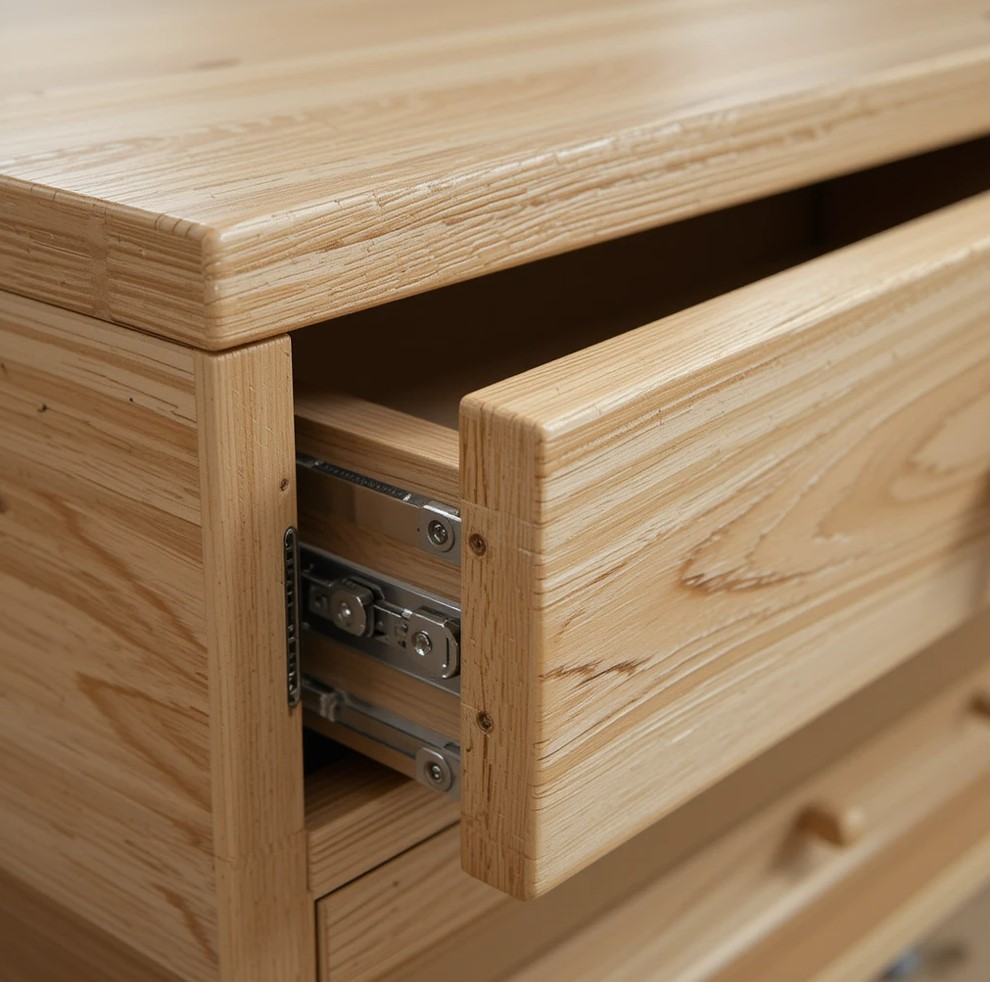

The hardware elements that link, secure and assemble various furniture pieces are known as fasteners in furniture fittings, and they are essential to the stability and structural integrity of the piece. They are chosen according to the design, materials and desired level of permanence of the furniture and range from basic fasteners like screws and nails to more intricate systems like cam locks and dowels.
1. Screws

A. Wood Screws:
- The most popular kind of assembling general furniture is this one.
- For a firm hold in wood, they have coarse threads and sharp points.
- A smooth shank close to the head guarantees a tighter fit and helps avoid splitting.
B. Confirmat Screws:
- They are often used to produce sturdy joints in MDF and particleboard for flat-pack furniture.
- They can sit flush with the surface because of their small head and wide thread.
C. Pocket Hole Screws:
- These screws produce strong, undetectable joins when used with a pocket hole jig.
- They are made of angled driving and have a broad head.
2. Nails

A. Types:
- Finish Nails: Because of their small head, these are perfect for applications like molding or trim where the nail head needs to blend in with the surrounding wood or be hidden.
- Brad Nails: Even thinner and smaller than finish nails, brads are appropriate for fine details and complicated work.
- Flooring Nails: These nails offer a firm grip during flooring installations and are made to work with a variety of flooring materials.
- Framing Nails: Framing nails are usually more robust and stronger and are used for larger building and structural components.
- Upholstery Nails: They are used to fasten fabric to the frame of furniture and they have large, ornamental heads.
- Screw Nails: These nails combine the best features of nails and screws, providing a nail-like ease of installation and a screw-like design for tight joints.
B. Advantages:
- Speed: For large projects, nails can be installed considerably more quickly than screws.
- Shear Strength: Because nails are so good at withstanding shear forces, they can be used on joints that slide or move literally.
- Ease of Removal (in some cases): Although nails are frequently used for permanent joints, in some circumstances they may be simpler to remove than screws, particularly if they are not clinched or pushed in too deeply.
C. Disadvantages:
- Pull-Out Resistance: In soft woods or if the nail is not driven in correctly, nails may be simpler to remove than screws.
- Splitting: Hardwoods may occasionally split when nails are driven into them, particularly if the nail is too big or the wood is not pre-drilled.
- Aesthetics: A countersunk screw may be more aesthetically pleasing than nail heads, which are occasionally visible.
3. Dowels:

A. How Dowels Work?
- Alignment: To guarantee a tight and perfect fit, dowels aid in precisely aligning the wood pieces being joined.
- Reinforcement: They distribute stress and keep the joint from twisting or tearing apart by acting as structural reinforcements.
- Fastening: Dowels and glue combine to form a robust, unseen joint that is capable of withstanding a lot of force.
B. Types:
- Plain Dowel Joints: These straightforward dowels are utilized for fundamental joints such as edge-to-edge and bottom junctions.
- Multi-Dowel Joints: Suitable for heavier furniture, multiple dowels spread the load across a larger area.
- Decorative Dowel Joints: Usually made of contrasting wood species, exposed dowels are used as a decorative feature.
- Cross Dowel Joints: In factory-made furniture, a threaded metal dowel is put into a slot and secured with a screw.
- Dowel Screws: They are headless fasteners used for hidden connections in furniture that have wood screw threads on both ends.
- Locking Dowels: Some dowels, especially those seen in flat-pack furniture, are made with locking mechanisms for simple and safe assembly.
4. Bolts and Nuts

A. Bolts:
- Function: Bolts are threaded fasteners that are fastened with nuts after being introduced through holes in two or more items.
- Structure: Usually, they are made up of a threaded shaft and a head that can be square, hexagonal etc.
- Types: There are various bolt types, such as carriage bolts, eye bolts and machine bolts, each of which is appropriate for a particular furniture application.
- Installation: To distribute the load and shield the furniture surface from harm, bolts are frequently used in conjunction with washers.
B. Nut:
- Function: The purpose of nuts, which are internally threaded fasteners, is to form a secure connection with bolts.
- Structure: They usually have a threaded hole in the middle and are square or hexagonal in shape.
- Types: Common types that provide different levels of security and aesthetic appeal are hex nuts, lock nuts, and cap nuts.
C. How do bolt & nuts work together?
- The furniture pieces have holes that are aligned for a bolt.
- Next, a nut is threaded through the exposed end of the bolt.
- The furniture pieces are held together by clamping force created by tightening the nut.
- When employed, washers assist disperse the clamping force and shield the furniture from harm.
5. Cam Locks

A. How cam lock works?
- Cam Lock Screw: The screw’s head slightly protrudes when it is put into a pre-drilled hole in one panel.
- Cam Lock Nut: The nut is placed into a matching hole in the other panel. It is typically cylindrical and includes a locking mechanism that resembles an arrow or claw.
- Engagement: The cam lock screw head slides into the cam lock nut’s claw when the panels are assembled.
- Locking: The two panels are secured together when the cam rotates and grasps the screw head when the cam lock nut is turned with a screwdriver, usually in a clockwise direction.
- Disassembly: By rotating the cam lock nut counterclockwise, the screw head is released, allowing the panels to be separated.
B. Benefits:
- Ease of Assembly: With just a screwdriver and no need for specialist equipment or carpentry knowledge, cam locks make furniture installation simple.
- Ability to Disassemble: Because they make it easy to disassemble and reassemble, they are suitable for flat-pack furniture.
- Invisible Joints: To keep the furniture looking neat and attractive, cam locks are frequently hidden inside it.
- Strength and Stability: Cam locks produce a strong and stable junction between the panels when they are installed correctly.
C. Types:
- Cam Lock Screws: Made to work with particular cam lock nuts, these screws come in a range of sizes and materials.
- Cam Lock Nuts: They are available in a variety of sizes and forms, and they frequently have an arrow-or claw-shaped locking mechanism.
- Cam Lock Bolts: These bolts provide a secure connection by passing through one panel and engaging with the cam lock nut on the opposite side.
6. Drawer Slides

A. Components:
- Drawer Slide: The component that is fastened to the drawer box.
- Cabinet Slide: The component that is fastened to the cabinet or furniture frame is called a cabinet slide.
- Ball Bearing or Rollers: Many slides use ball bearings or rollers, which lessen friction between the two parts and enable easy, smooth operation.
- Full Extension: Some drawer slides provide full extension, which enables the drawer to be fully opened for optimal access to its contents.
- Soft-Close: To avoid slamming, some drawer slides have a soft-close mechanism that gradually slows the drawer’s closing.
- Locking Mechanism: To keep the drawer secure in both open and closed positions, certain drawer slides use locking mechanisms.
B. Types:
- Side-Mount: This combination of affordability and functionality is achieved by attaching the slides to the sides of the drawer and the cabinet.
- Undermount: These slides provide a more discrete and frequently smoother functioning because they are fastened to the drawer’s bottom and the cabinet’s underside.
- Center-Mount: Mainly used in simpler, less demanding situations, these slides are fastened to the middle of the drawer and the cabinet.
- Other Types: Specialized slides, such as locking and push-to-open slides, are also available; each is made to meet certain requirements.