

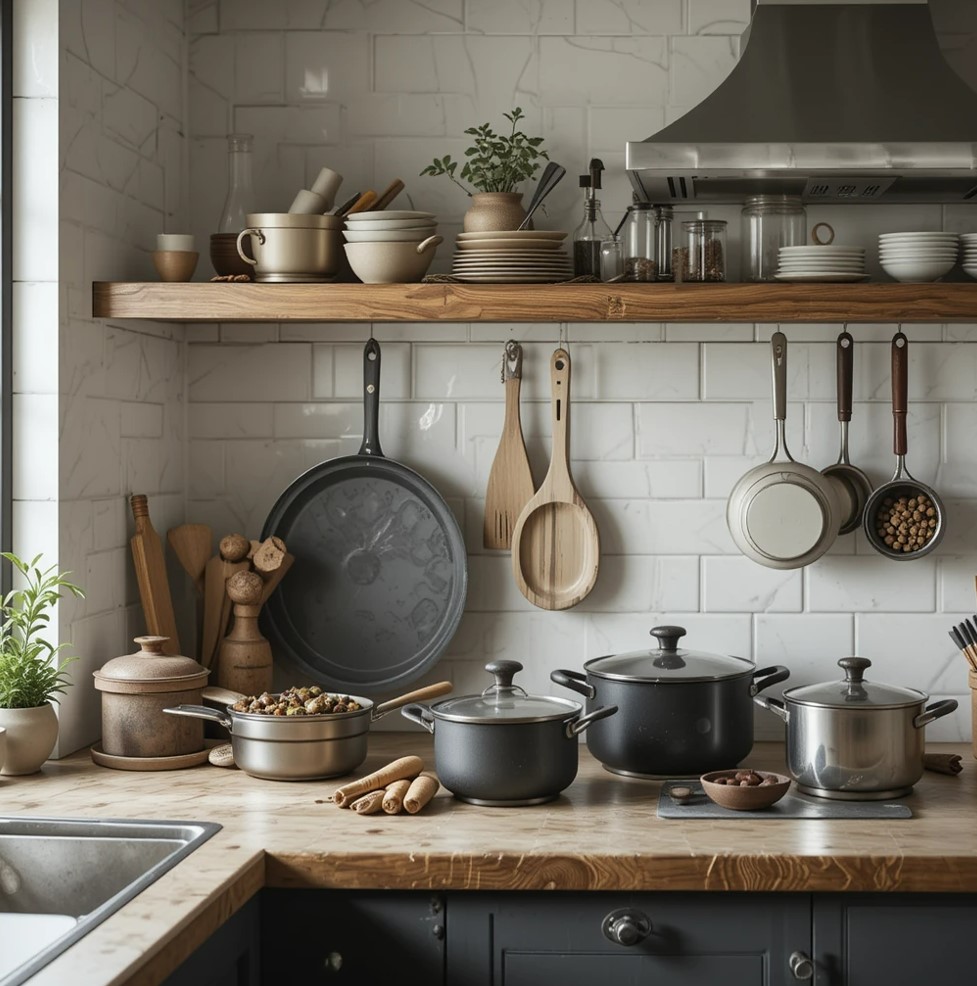

A home kitchen needs constant improvements, we all know that clearly, because that’s where the real homework happens, this isn’t any different from the actual homework given in school, what’s important for students is important for the bosses of the kitchen as well. And our lovely home makers are busy in and out of stuff that are important enough to get things done at the moment. Here we name and explain some kitchen appliances that magically make the kitchen work smooth. Their undeniable work makes happy faces ranging from kids to grown-ups, especially in busy mornings. Now we should wonder where we were if none of them are discovered so far, that surely will make us grateful for what we have right now.
1. Hand Tools

a. Knives:
- Chef’s Knife: A necessity in any kitchen, this is the most adaptable knife. It can be used to slice meat, cut veggies, and more.
- Paring Knife: These knives are lightweight and compact, making them ideal for delicate tasks like peeling and coring.
- Bread Knife: Bread can be cut with this long, serrated blade without being crushed or torn.
- Utility Knife: Utility knives are ideal for activities requiring both a chef’s knife and a paring knife.
- Cleaver: A heavy, wide-bladed knife for cutting through tough foods and bones.
- Boning Knife: Mainly used to separate or remove hard bones from meat, fish, and poultry.
- Carving Knife: A long, thin, sharp-pointed knife for cutting and slicing prepared foods.
- Butcher Knife: A big knife with a long, curved blade that is used to effortlessly and neatly cut into meat, usually with a sawing motion.
- Fillet Knife: A narrow bladed, flexible knife for filleting fish.
- Santoku Knife: This Japanese style knife is perfect for slicing and chopping vegetables since it resembles a chef’s knife but has a flat blade edge.
- Nakiri Knife: Another straight, flat-edged Japanese knife used especially for slicing vegetables.
b. Peelers:
- Straight Peelers: The handle and blade are often parallel, much like a knife. Ideal for peeling cucumbers and carrots, which are long, straight vegetables.
- Y- Shaped Peelers: The blade is perpendicular to the handle and shaped like a “Y” in the alphabet. Perfect for removing the peel from big, spherical fruits and vegetables.
- Swivel Peelers: The blade can follow the vegetable’s outlines because it pivots. Ideal for an easy handling of odd forms and precise peeling.
- Julienne Peelers: Often seem like a straight peeler or Y-peeler, but they include a specific blade for slicing small vegetable stripes. Ideal for making Julienne salad or garnish veggies.
c. Kitchen Graters:
- Box Grater: These graters can be used with a variety of foods, including cheese, veggies, and chocolate, because they have four different grating surfaces: fine, coarse, slicer and shredder.
- Micro Plane Grater: These graters are renowned for having incredibly sharp blades that are perfect for delicately shredding hard cheeses, spices and citrus zest.
- Rotary Grater: These graters work well for swiftly and consistently shredding big amounts of cheese, nuts or vegetables.
- Handheld Grater: This grater is compact and simple to use, making them perfect for small-scale activities like shredding ginger or zesting citrus fruits.
- Zester: A zester is a kind of rasp grater that is ideal for grating hard cheese or zesting citrus because of its long, narrow grating surface.
- Mandoline: Vegetables are cut into uniformly these slices using a mandoline, which frequently has thickness settings that may be adjusted.
- Rotary Drum Grater: These graters effectively prepare foods like cheese, nuts, and vegetables by using a revolving drum with a grated surface.
d. Egg Slicers: An egg slicer’s main purpose is to quickly and consistently cut hard-boiled eggs into slices, which is perfect for salads, sandwiches and other recipes that call for uniformly sized egg pieces. In addition to a shallow dish or tray to hold the egg, egg slicers typically contain a hinged lid or plate with many wires or blades evenly spaced apart. A hard-boiled, peeled egg is placed into the base, and the hinged top is pressed down to allow the wires or blades to cut through the egg and develop uniform slices
e. Spoon: A frequent eating tool for moving food from a plate or bowl to the mouth is a spoon. Stainless steel, silver, wood, porcelain, and plastic are just a few of the materials used to make spoons.
f. Spatula: A spatula is a broad, flat, and frequently flexible kitchen implement used for lifting, turning, scraping and spreading food. It can be used to spread frosting, flip pancakes, pull food from pans, and even combine or mix ingredients.
g. Salad Tongs: They are specially made kitchen utensils that are used to carefully pick up and serve salad items without breaking them. It is simple to scoop and lift salad pieces with their two hinged arms, which frequently have spoon-like ends. Both tossing and serving are made comfortable by their lengthy handles.
h. Ladles: Serving liquids like soup or stew is the main function for a ladle, which is a big spoon with a long handle. Because it is used to load dishes with liquid, the name “Ladle” is derived from the Old English word “hlaedel”, which means to load.
2. Cookware
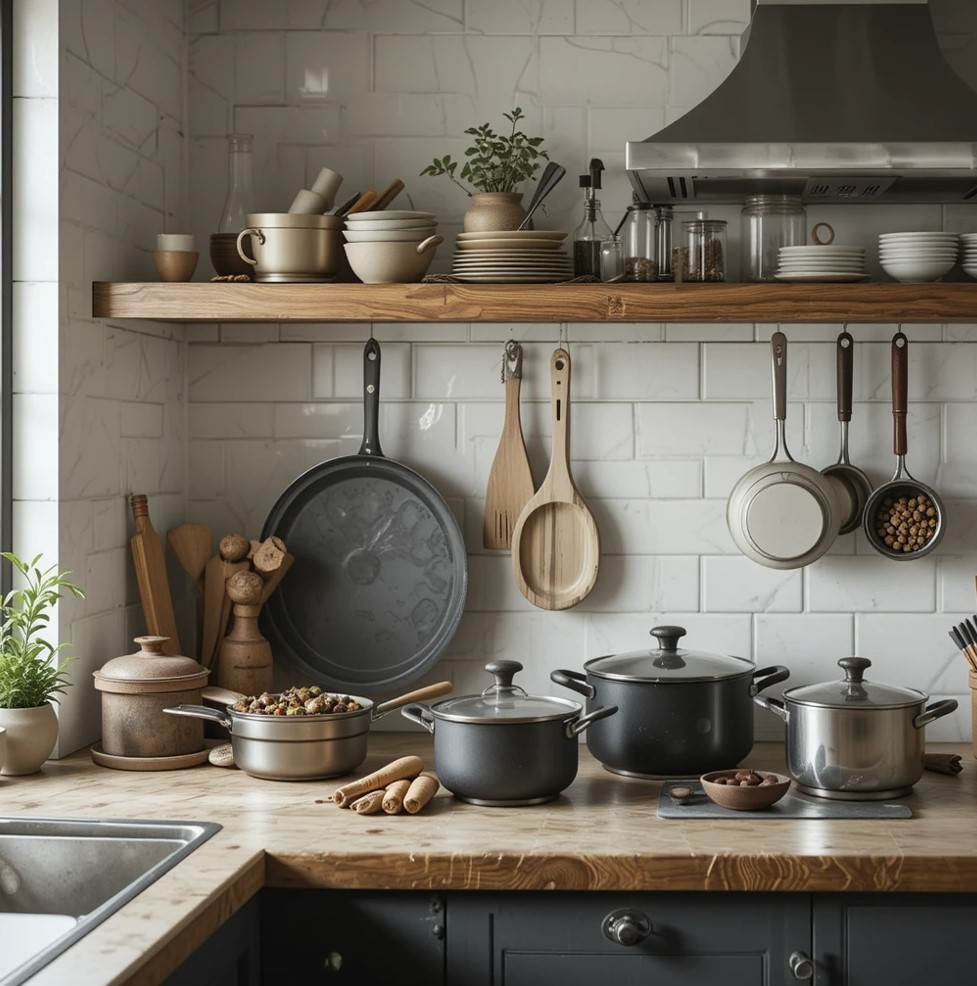
a. Pots:
- Saucepans: Adaptable pots with long handles and high edges that are ideal for boiling grains, simmering sauces, and heating liquids.
- Sauce Pots: Like saucepans, but bigger in volume, with taller sides and a bigger base, these are perfect for braising or cooking greater amounts of sauces.
- Stock Pots: The biggest cooking pots are made to prepare big quantities of stocks, soups, and other liquid-based foods.
- Dutch Ovens: Wide, heavy pots with tight-fitting lids that are used for baking, braising, and slow cooking.
- Pasta Pots: Pasta is easy to cook and drain in tall, thin pots with built-in strainers.
- Double Boiler: Two nestled pots that can be used to cook delicate sauces, melt chocolate, or make custards.
- Brazier (Rondeau Pan): Wide, shallow pans that have a broad cooking surface are perfect for braising vegetables and meats.
b. Pans:
- Fry pans (Skillets): Shallow pans for frying, searing, and sauteing that have low, sloping sides.
- Grill Pans: Pans with ridged sides that allow food to get grill marks.
- Saute Pans: Like fry pans, but with somewhat steeper sides, these are perfect for frying and sauteing bigger amounts.
- Sheet Pans: Rectangular, flat pans that can be used for sheet pan dinners, baking cookies, or roasting veggies.
- Roasting Pans: Large chunks of meat and poultry can be roasted in the oven using shallow, rectangular pans with high sides.
c. Steamers:
- Atmospheric Steamers (Convection Steamers): While cooking, the steam is continuously evacuated from these steamers, which use steam at atmospheric pressure. By using a fan to move the air and steam throughout the cooking area, they provide a somewhat more equal temperature distribution.
- Pressure Steamers: For speedier cooking and more tenderized results, especially for meats and stews, these steamers run at higher pressure (5-15psi).Their sealed chamber keeps the pressure constant, allowing the food to cook quickly and efficiently.
- Electric Steamers: These are compact countertop devices that heat water and produce steam using electricity. They frequently have several stages so that different dishes can be cooked at the same time.
- Bamboo Steamers: These classic bamboo steamers are renowned for their capacity to absorb excess moisture and provide a mild heat.
- Stainless Steel Steamers: These steamers uniformly distribute heat, are long lasting, and are simple to clean. Often, a glass cover is incorporated for convenient meal monitoring.
- Rice Cookers/Steamers: These appliances are made especially to use the steaming method to prepare rice and other grains.
- Microwave Steamer: They provide a quick and easy way to steam food and are made to be used in microwaves.
- Grill Steaming: Using a grill with a steamer insert, this technique uses steam to cook food.
d. Colanders:
- Metal Colanders: Typically feature a stable rim and a strong base. They are appropriate for draining hot liquids since they are strong and heat resistant.
- Plastic Colanders: Characteristics like sink clips for simple draining and the ability to be lightweight. They may eventually discolour even though they are usually less expensive than metal colanders.
- Silicone Colanders: They frequently have non-slip qualities and are foldable for convenient storage. They are resilient to heat, flexible and long lasting.
- Ceramic Colanders: Often just have holes in the bottom. They may be lightweight and aesthetically pleasing, but they are not as durable as metal or silicone colanders.
e. Woks:
- Cantonese-style: Two U-shaped handles and a rounded bottom make it ideal for serving big portions.
- Northern-style: With one long handle and occasionally a smaller helper handle, it resembles a skillet more.
- Round-bottomed: For stability in contemporary cooktops, a wok ring is necessary.
- Flat-bottomed: They take a seat straight on modern, ringless cooktops.
3. Processing Equipment
a. Blenders:
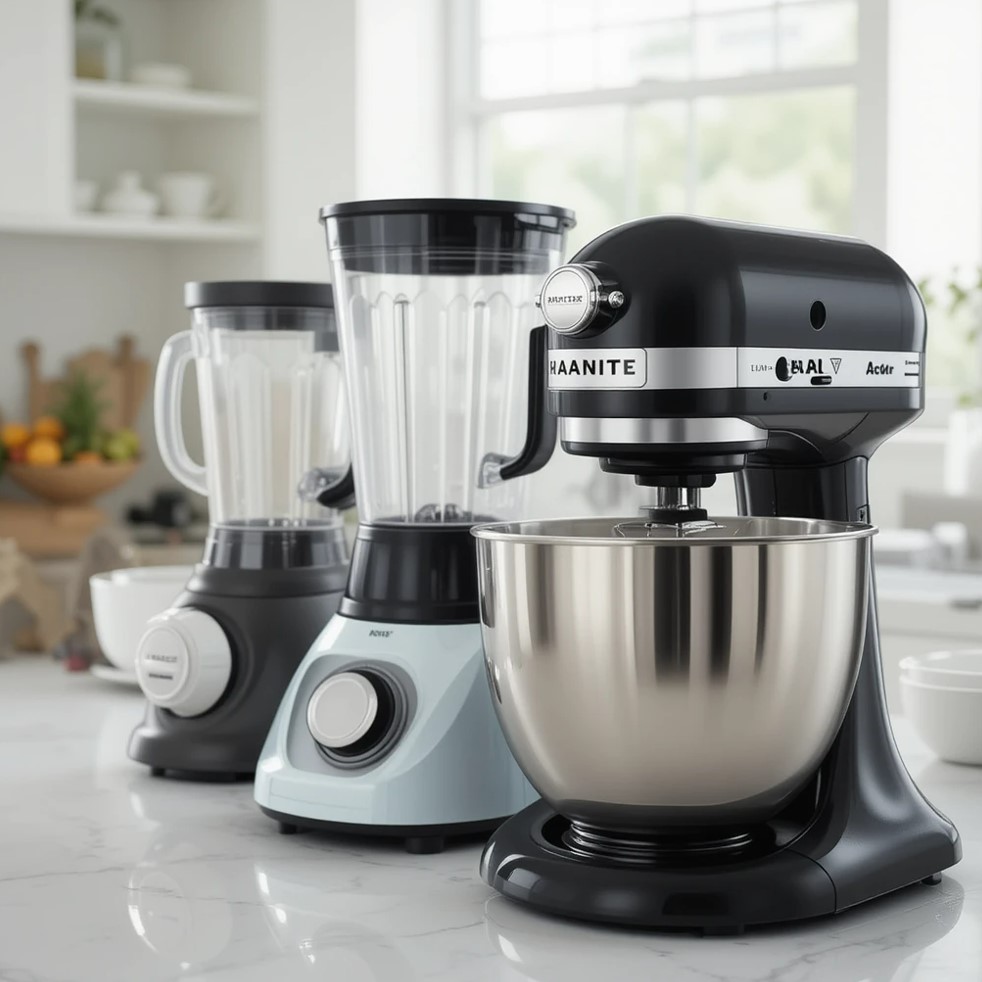
- Countertop Blenders: These countertop blenders feature blades, a blending container, and a motor base. They are adaptable, capable of handling a range of blending tasks, frequently featuring numerous programs and speed settings. They may not be as portable and may require counterspace. They can be used in blending soups, sauces, smoothies and other foods.
- Immersion (Stick) Blenders: Handheld blenders that have a motor and a bladed, extended arm. They are space-saving and easy to blend straight in bowls, pots and pans. It could not be as strong as countertop blenders and might not be as steady while mixing hot liquids. They are mainly used in making emulsions by pureeing soups, sauces and other liquids.
- Personal Blenders: Smaller countertop blenders, frequently with the ability to serve one person at a time. They are small, clean and excellent for creating individual protein shakes, juices and smoothies. But they may not be as strong as countertop blenders. They can be used in preparing single portions of shakes, purees and smoothies.
b. Mixers:
- Stand Mixers: The manner the bowl is raised or tilted for access allows stand mixers to be further classified. While tilt-head variants are smaller and less expensive, bowl-lift models are more durable and heavy duty. They usually have several speeds, several attachments (such as a paddle, dough hook, and whisk), and frequently a kneading bar for dough preparation.
- Hand Mixers: Because of their portability and minimal weight, these are appropriate for minor jobs or situations where a separate mixer is not required. For a variety of mixing jobs, they frequently include a variety of attachments, such as beaters and whisks.
c. Electric Kettles:
- Standard Electric Kettle: The simplest kind, made only for heating water.
- Temperature-Controlled Electric Kettle: Make it possible to choose the perfect temperature, which is perfect for making particular kinds of tea or coffee.
- Glass Electric Kettle: Usually made of heat-resistant glass and offers a stylish appearance.
- Stainless Steel Electric Kettle: Long-lasting, heat efficient and simple to maintain.
- Travel Kettle: Small and portable, frequently with a small capacity.
- Gooseneck Kettle: Often used for pour-over coffee, it has a curved spout for accurate and controlled poring.
- Cordless Kettle: Provides convenience by removing the need for a cable to lift and pour the kettle.
d. Meat Grinders:
- Manual Meat Grinders: These grinders produce ground meat by forcing the meat through a sequence of blades and perforated plates with a hand crank. They are more portable and reasonably priced than electric ones. But manual labor is necessary, and it is not recommended for frequent use or big quantities.
- Electric Meat Grinders: Compared to manual grinders, the grinding process is quicker and more effective thanks to an electric motor. They are practical for people who often cook ground beef meals and for big quantities of ground meat. But they may need more storage space and it has a higher initial cost.
4. Heavy Cooking Appliances
a. Ovens:
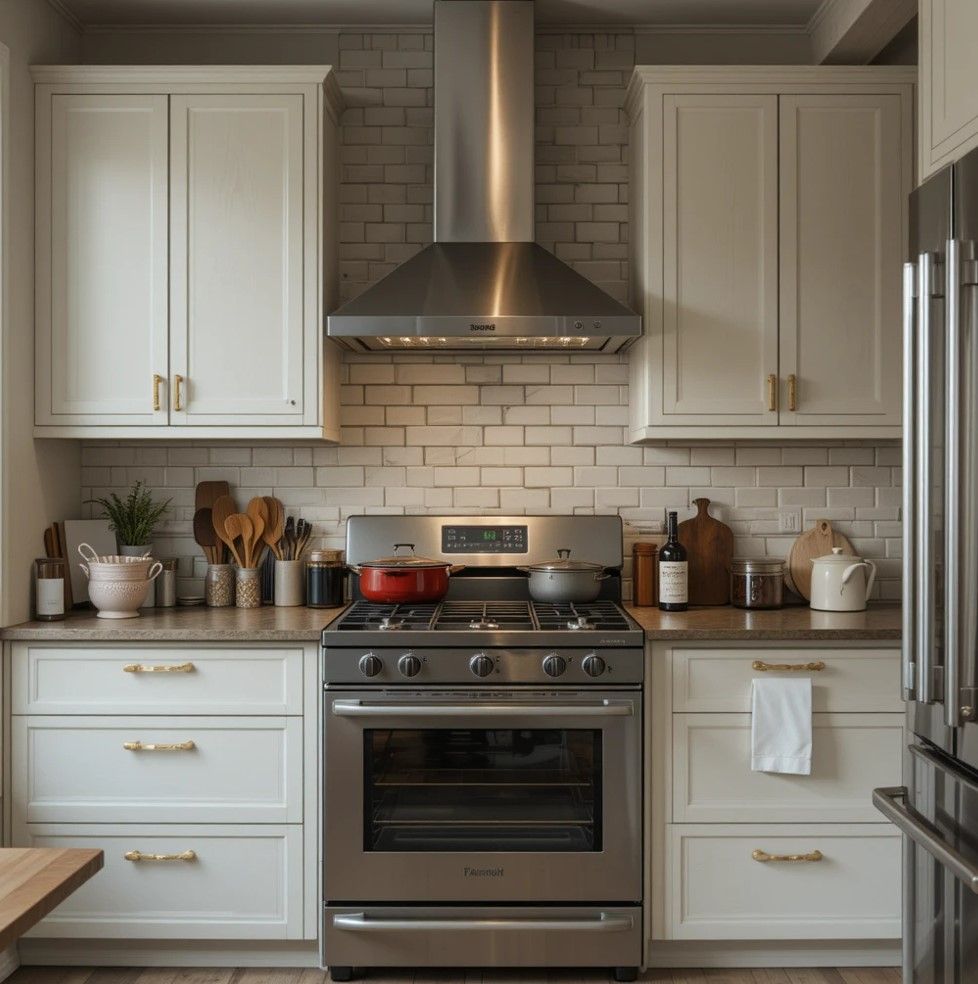
- Conventional Ovens: These are the most common kind, with a boiler frequently at the top and a single heating element (typically at the bottom). They work well for simple cooking and baking.
- Convection Ovens: With the use of a fan that circulated hot air, these cook food more quickly and evenly. They are perfect for making crispy roasts or baking several pans of cookies.
- Steam Ovens: These preserve tastes and nutrients by cooking food with steam. They work well with veggies and other foods that call for wetness.
- Combination Ovens: The output is done by combining convection ovens and microwave technologies into one and the result is pretty much very good, because they do well in kitchens.
b. Stoves:
- Gas Stoves: These stoves provide quick heat and fine temperature control by heating using open flames. Their reactivity makes them a popular choice for both home cooks and chefs.
- Electric Stoves: Cookware is heated by coils or heating elements in electric stoves. For ease of cleaning, some electric stoves have a flat, smooth ceramic-glass surface.
- Induction Stoves: These stoves are sensitive and energy-efficient because they heat cookware directly using electromagnetic induction. Additionally, they provide a level surface for effortless cleaning.
c. Microwaves:
- Solo Microwave: These are the simplest models, and their main functions are defrosting and reheating. Beyond simple heating they don’t provide many culinary possibilities.
- Grill Microwave: In addition to cooking food in the microwave, these microwaves have a grilling element that enables food to be browned and grilled. They frequently have features like a dedicated grilling rack.
- Convection Microwave: These are the most adaptable kind since they combine the power of a microwave with the capability of a convection oven. They facilitate baking, roasting, and grilling by circulating hot air through a fan and heating element. Convection microwaves are perfect for a variety of cooking jobs because they provide reliable temperature and effective heat distribution.
5. Storage Equipment
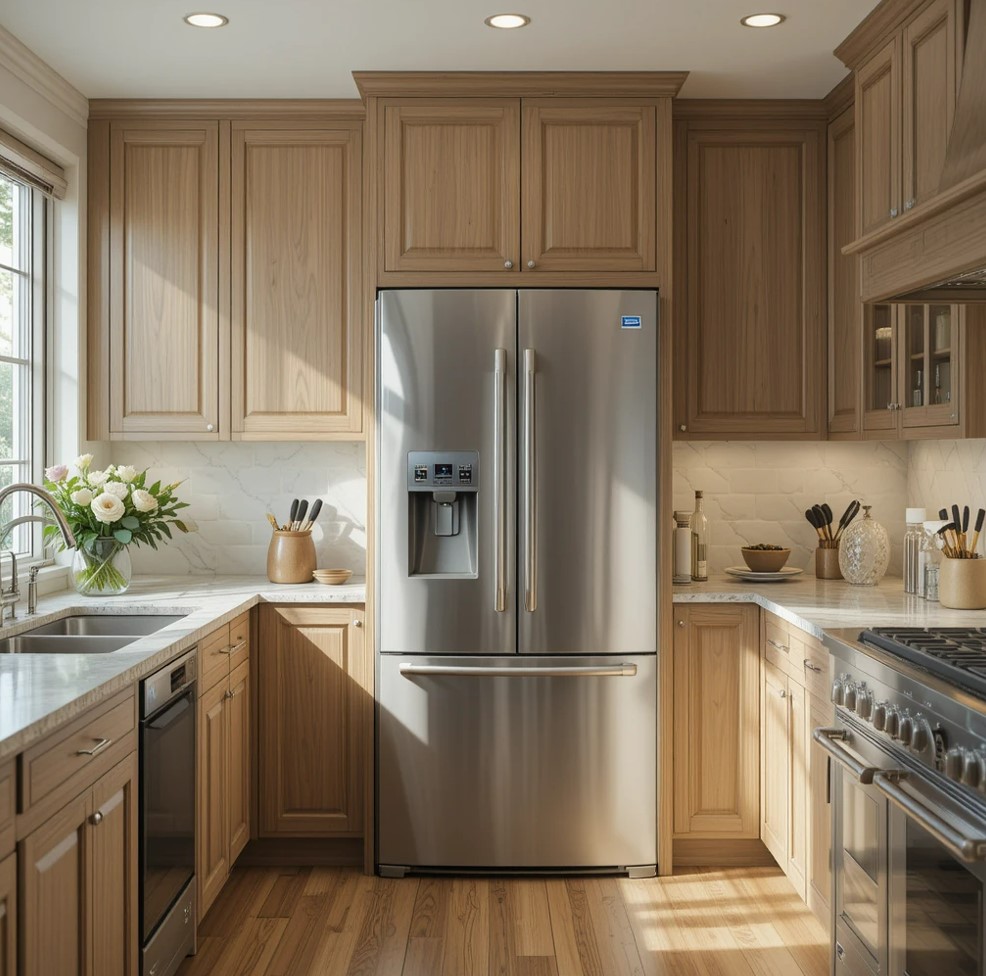
a. Refrigerator and Freezer:
- Top-Freezer: This works in the conventional or old way that the freezer is located in the top of the refrigerator. The freezer may be less accessible than bottom-freezer models and may have less freezer space than other varieties.
- Bottom-Freezer: The freezer, which frequently has a pull-out drawer, is situated beneath the refrigerator. The freezer is frequently wider, providing more room for frozen goods, while fresh food storage is easier to access.
- Side-by-Side: The refrigerator is on one side and the freezer is on the other forming two vertically aligned chambers. They provide a large amount of storage space and convenient access to both frozen and fresh goods. But it may take up a lot of room and isn’t the best option for little kitchens.
- French Door: It has a large refrigerator section with two half-width doors that open, frequently equipped with a pull-out drawer or bottom freezer. They provide quick access to fresh food, spacious shelves, and a contemporary appearance. But compared to side-by-side models, it could be more expensive and have less freezer space.
- Counter-Depth: Designed for a seamless appearance by fitting flush with kitchen counters. Because they are shallower than typical models, they are perfect for kitchens with little space. But it could be smaller overall than typical refrigerators.
- Undercounter: Smaller refrigerators that may be placed beneath kitchen countertops are frequently utilized in bars and other areas for additional storage. They offer more storage space in cramped spaces like a wine cellar or bar. In comparison to large models, it could not have as much storage space.
- Built-In: Incorporated into kitchen cabinets, giving them a smooth and polished appearance. They provide a kitchen appearance that is more integrated and smoother. But they may be more costly and require bespoke cabinetry.
- Freezer Less: A refrigerator without a freezer that simply has a refrigerator section. It is perfect for people who mostly depend on storing fresh food. But it may be unsuitable for people who must keep frozen goods in storage.
- Smart Refrigerators: Refrigerators with cutting-edge features like touchscreen displays, integrated cameras and smart home connectivity. They provide efficiency and convenience with features including energy-saving modes and food inventory management. They may be more costly and necessitate a greater degree of technical expertise.
- Dual Door: The freezer and refrigerator compartments are stacked vertically behind a single door. Most likely a compact design, perfect for tiny kitchens. But it has not as much storage as larger models.
b. Pantry Shelves:
- Fixed Shelves: These shelves provide a straightforward and affordable storage option and are permanently placed. They work well for keeping things that aren’t used very often or that are about the same size.
- Adjustable Shelves: Give yourself some leeway in modifying the shelf height to fit products of different shapes and sizes. This is especially helpful for keeping things like cartons, bottles, and cans organized.
- Pull-Out Shelves: They are perfect for reaching products kept in tight areas at the back of the pantry since they slide in and out on tracks. They also keep things from being shoved to the back of the pantry and assist to keep it organized.
- Rotating Shelves: Make effective use of corner space by letting shelves revolve around a central point. This saves room and facilitates access to goods in the corner.
- Deep-Set Shelves: They give bigger and heavier things plenty of storage space for simpler access, they can be mounted on sliders.
- Shallow Shelves: Perfect for storing goods that don’t need deep storage or for small pantries or confined areas. They maintain everything’s accessibility and visibility.
- Open Shelving: Offers more storage space and a means to display lovely dishes or utensils.