


We all always dream about buying a house or building one in our own way, uniquely responsible for our creativity. We may get some inspiration from the posts or blogs around the world but we do it like, it’s our own intellectual property. A touch of personal brilliance, which can speak clearly about our undying desire for a peaceful home. Our kids will enjoy the creation with an awe in their minds, and of course, our neighbors and relatives too, follow the same emotion. It all happened because someone dreamed about it deep inside. And it surely happens for sure because that’s how the world works. You dream it, you create it.
1. Conventional Ceilings

It offers a clean minimalist look, because the most defining characteristic of the conventional ceiling is its lack of complex designs or textures or decorative details. In some designs, standard ceiling heights may extend up to 12 feet for a more open feel, but usually it is 8.5 to 10 feet. Most common materials used in conventional ceilings are drywall and plaster, providing a durable and paintable surface. Conventional ceilings are straightforward, but they may be personalized with different paint jobs, finishes, trim, lighting fixtures and ornamental accents to match various design styles. Simple installation and repairs are made possible by their accessibility and ease of maintenance. They are budget friendly because of their simple construction and material usage. They are a practical choice for hiding elements like, wiring, ductwork and other structural items, keeping the room looking clean and organized.
2. High Ceilings

By making rooms appear larger and more luxurious, high ceilings create a more spacious and elegant feel. Higher ceilings make the space feel brighter and more-airy because they often allow for larger windows, bringing in more natural light. High ceilings can help keep the rooms cooler in summer and warmer in winter, and they facilitate better air circulation. For creative design elements like chandeliers, tall bookcases and even multi-level living spaces, high ceilings offer opportunities. Due to their perceived luxury and spaciousness, homes with high ceilings tend to have a higher resale value. Cleaning high ceilings potentially requires specialized equipment or professional assistance because it can be more challenging and time consuming. High ceilings may make the furniture appear smaller, so location and choice must be carefully considered. Sometimes noises are amplified by high ceilings, which could cause increased echo or reverberation in particular places.
3. Vaulted Ceilings

Any ceiling that rises toward the roof at an angle greater than the standard 8-10 foot height of flat ceilings is called a vaulted ceiling. Arched, barrel, cathedral, domed, groin, and rib vault ceilings are examples of common ceiling styles. These ceilings are typically constructed by building a separate vaulted structure below the roof or removing portions of the roof structure. The main materials that can be used in vaulted ceilings are, wood, plasterboard and even locally pressed soil- cement tiles, in some cases. The designed vaulted ceilings can enhance natural light, ventilation and acoustics. From Gothic cathedrals to Mediterranean villas, vaulted ceilings have been used in various architectural styles throughout history. The main pros of this type of ceiling, it can increase the visual size of a room, improve acoustics, and enhance natural light. And the cons can be, it is more expensive to construct, requires more energy to heat or cool, and likely more challenging to maintain.
4. Dome Ceilings

A hollow, spherical or semi-spherical ceiling that rises without columns is called a dome ceiling. It can be compared to an arch that forms a curved roof by rotating around a central axis. There are many different types of domes, including elliptical, half circle, and soft shapes. They are often found in entryways (foyers), dining rooms, master bedrooms, studies, above circular staircases, media rooms and powder rooms. The dome will be positioned inside a square aperture framed in the ceiling. Materials like, drywall, plaster, wood veneer, brick veneer, trim, tile or other desired items, are used to finish the dome. To enhance the dome’s visual interest, texture such as faux finishes or murals can be added. Indirect illumination on the dome can be achieved by adding inner light rings. The dome’s color should complement the room’s overall color palette.
5. Coffered Ceilings

A coffered ceiling is identified by a grid of beams or molding that forms several coffers, or recessed panels. Usually, the coffers form a geometric pattern, mainly squares or rectangles, though they can also be octagonal or other patterns. Beyond aesthetics, coffered ceilings even create the illusion of a higher ceiling, improve sound absorption, and can help hide ceiling imperfections. With examples found in ancient Roman and Renaissance structures, coffered ceilings have been used in architecture for centuries. Coffered ceilings, which were once constructed of wood or plaster, can now be constructed using drywall or other materials. The coffers’ depth and shape can vary from basic to intricate, providing a variety of design options. Even now, coffered ceilings are in style, lending richness and beauty to both traditional and modern spaces.
6. Tray Ceilings

By making the room feel more luxurious and refined, tray ceilings add a touch of elegance and sophistication to the room. Even in smaller spaces, the raised center section of a tray ceiling can make a room feel larger and more open. The design of a tray ceiling draws the eye upwards and adds a focal point to the room, which also introduces depth and visual appeal. By enhancing the overall cleanliness and tidiness of the space, tray ceilings provide a discreet way to conceal wiring, pipes, and even vents. From modern to traditional, tray ceilings can be incorporated into various architectural styles, making them a versatile design option for any home. Tray ceilings allow unique ambiance, by offering ample space for creative lighting designs, such as recessed lights, LED strips, or accent lighting. By adding a sense of space and sophistication to the interior, a tray ceiling can play a vital role in raising the home’s expected buying value.
7. Sloped Ceilings
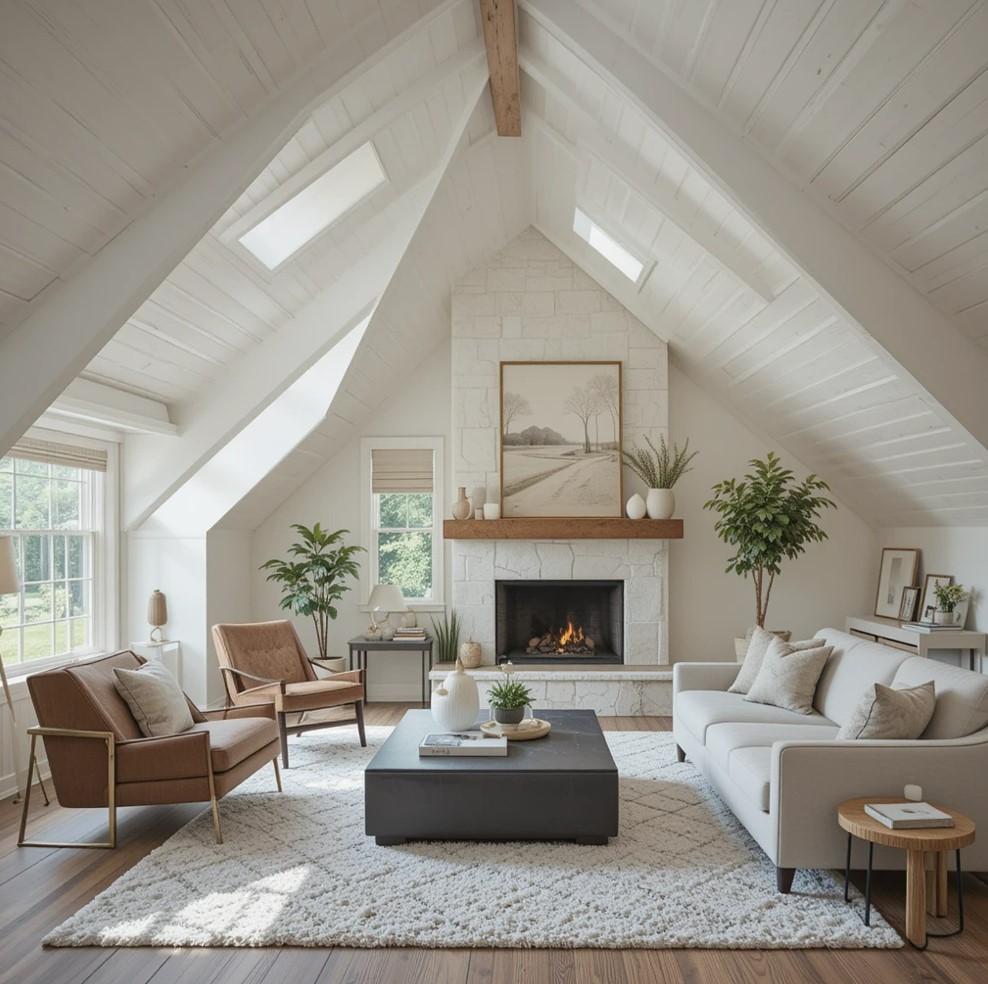
Sloped ceilings can maximize natural light, especially those with high clerestory windows. Mainly in attics or other areas where ceilings are typically low, sloped ceilings can open up a room, making it feel larger and more spacious. Like beams, exposed rafters, and creative lighting fixtures, they offer unique opportunities for design elements. Vaulted ceilings, can ventilate a room by allowing warm air to rise and escape, with the help of their high clearance. The room’s focal point can be the roof structure, which is visually emphasized by the sloped ceiling. It may be difficult to utilize a room’s entire height for furniture placement and storage due to the sloping walls. To maximize the area, take into account bespoke window treatments, furniture and shelving.
- Single Slope: Frequently seen in single story extensions or shed roofs, this type of roof slopes in a single direction.
- Triangular/A-frame: Forms a triangle by sloping in two directions.
- Vaulted: A tall, upward-slopping ceiling with uneven or symmetrical sides.
- Cathedral: This kind of vaulted ceiling frequently follows the roofline and has symmetrically sloping sides.